
Daily Care
Water flosser vs floss: which one should you use?
A water flosser is not only for braces, and it is not a magic upgrade either. Here is what the trials found, where each tool helps most, and how to decide for your mouth.
On this page (10 sections)
If your gums bleed when you floss, or floss is so fiddly that you skip it, a water flosser can look like the answer. In the water flosser vs floss choice, both are recognized ways to clean between your teeth, and the best one is the one you will use every day. The American Dental Association (ADA) lists water flossers alongside floss as interdental cleaners, and its MouthHealthy site says a water flosser can be useful if you find other tools hard to work with, and may help people with braces, bridges and other dental work reach every spot.
So a water flosser is not just for braces, and it does not have to replace string floss. The evidence is honest but thin: a Cochrane review found water flossers may reduce gum inflammation more than floss in the short term, with low- to very low-certainty evidence, and a 2023 review of seven smaller trials mostly favored water flossers for plaque. This guide sets out what each tool does well, what the studies found, the cost, and a simple way to decide if your gums bleed.
Key takeaways
- Clean between your teeth once a day with floss or another interdental cleaner; a toothbrush alone cannot reach those surfaces well (ADA).
- A water flosser uses a stream of water to rinse away food and plaque (MouthHealthy). It suits people who find floss hard, and people with braces, bridges or other dental work.
- Cochrane: water flossers may reduce gum inflammation at one month compared with floss, but not plaque; the evidence is low to very low certainty.
- Floss suits tight spaces; interdental brushes suit wider gaps and gum disease (ADA). Interdental brushes may beat floss for gum inflammation (Cochrane).
- Water flossers can be expensive and need water and electricity, which makes them harder to use away from home (2023 systematic review).
- Look for the ADA Seal of Acceptance on any interdental cleaner (ADA).
Decide in one minute
- Floss works, you use it daily, and your gums are settling? Keep flossing.
- You skip floss because it is fiddly, or you have braces, a bridge or implants? A water flosser is a reasonable switch. (If flossing hurts, ask your dentist to check why.)
- Your gums still bleed after a few weeks of daily cleaning? Book a cleaning and exam before buying more gear.
Water flosser vs floss at a glance
| Factor | String floss | Water flosser |
|---|---|---|
| How it cleans | Removes trapped food and the film of plaque along the gumline (ADA) | A stream of water rinses away food and plaque (MouthHealthy) |
| Best for | Tight spaces between teeth (ADA) | People who find other tools hard; braces, bridges and other dental work (MouthHealthy) |
| Gum inflammation, short term | May reduce it when added to brushing (Cochrane) | May reduce it more than floss at one month (Cochrane, low certainty) |
| Plaque | Results inconsistent (Cochrane) | No clear difference from floss in Cochrane; a 2023 review of 7 trials mostly favored water flossers |
| Skill needed | Technique-sensitive and takes practice (2023 review) | Generally easier to use (2023 review) |
| Cost and setup | No power or water tank needed | More expensive; needs water and electricity, harder to use away from home (2023 review) |
| Safety | Should not hurt if gentle (MouthHealthy) | No serious harms in the Cochrane trials that checked |
What the studies found, and how much to trust them
Three pieces of evidence matter most, and each has limits worth knowing before you spend money.
Cochrane review, 2019 (35 trials, 3,929 adults)
Water flossers used with brushing may reduce gum inflammation at one month compared with brushing alone, but not at three or six months, and showed no difference in plaque. Compared with floss, there was some evidence that water flossing may reduce gum inflammation more in the short term, but not plaque. Overall the evidence was low to very low certainty, and the authors say the effects may not be clinically important.
Systematic review, 2023 (7 trials)
Most of the included trials favored water flossers over floss for plaque reduction, including from hard-to-reach areas, and the authors suggest water flossers as an effective alternative for people with limited dexterity, braces or dental prostheses. But the trials were small and so different from each other that the authors could not pool them into one result, and they note that water flossers can be expensive.
Randomized trial, 2025 (82 young adults enrolled, 78 completed)
This trial compared a water flosser with an interdental brush, not with floss. In people with moderate gingivitis, four weeks of a water flosser led to less gum bleeding than an interdental brush, with no difference in gum abrasion. Worth knowing: the first author was an employee of the water flosser's maker when the study was run, and the maker funded the study and supplied the products.
Put together: a water flosser is a reasonable tool with some short-term evidence for calmer gums. It is not proven to beat floss over the long term, and no trial here measured cavities between teeth. Everyone's mouth is different, so judge it by your own result.
Where a water flosser actually helps
Based on the ADA, MouthHealthy and the 2023 review, a water flosser earns its place in these situations:
- Braces, bridges, crowns joined together, or other dental work. MouthHealthy says a water flosser may help people with this kind of dental work reach every nook and cranny.
- Hands that make flossing hard. Stiff fingers or a sore wrist make floss fiddly; the 2023 review names limited manual dexterity as a reason to choose a water flosser.
- You keep skipping floss. The ADA says the type of floss matters less than how and when you use it. A tool you use daily beats a better one in the drawer.
And where floss or a brush may be the better pick:
- Very tight contacts. The ADA says floss may be the choice for tight spaces between teeth. See how to floss properly for a gentler technique.
- Wider gaps, or gum disease already diagnosed. The ADA suggests interdental brushes for more open spaces and for people with periodontitis, and Cochrane found interdental brushes may reduce gum inflammation more than floss. The guide on how to use interdental brushes shows how to size them.
- Travel and tight budgets. The 2023 review notes water flossers can be expensive and need water and electricity, so they are harder to use away from home.
What about supplement ads? None of the sources here lists a supplement as a substitute for daily cleaning between your teeth. If ads for ProDentim or ProvaDent have you wondering, the ProDentim review and the ProvaDent review set each vendor's claims beside the published evidence.
No tool removes tartar
Plaque that is not removed hardens into tartar, which can only be removed by a dental professional (ADA). If your gums bleed, a water flosser can be part of the daily routine, but it does not replace a cleaning. The guide to bleeding gums explains what else can cause it.
How to use a water flosser, step by step
Follow the maker's instructions for your model. These general steps keep it gentle and tidy:
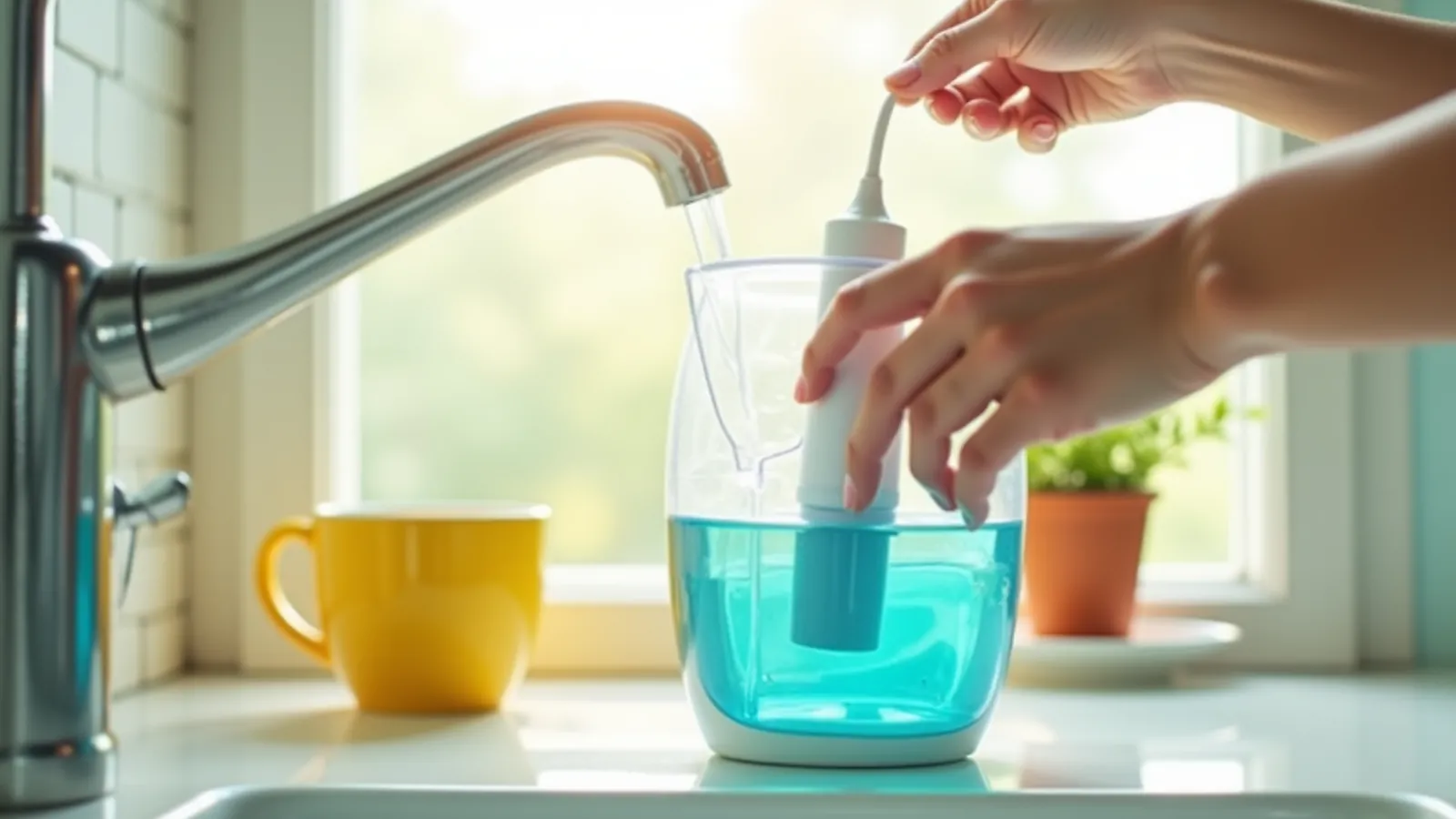
Fill and start low
Fill the reservoir with lukewarm water (as in the 2025 trial) and start on a comfortable low setting, following the maker's instructions for your model.
Lean over the sink
Put the tip in your mouth before switching on, close your lips enough to stop splashing, and let the water run out into the sink.
Trace the gumline
Aim the tip at the gumline, at a right angle to the tooth, and move slowly around the mouth, pausing briefly at each gap on the outside and the inside (the method used in the 2025 trial).
Give dental work extra time
Go slowly around braces, bridges, crowns and implants, where MouthHealthy says a water flosser can help you reach.
Once a day, every day
Clean between your teeth once a day (ADA). Brush twice a day (ADA) with a fluoride toothpaste (NHS); the order does not matter as long as you are thorough (ADA).
Judge it after a few weeks
Trials measured results at about two to four weeks and later. If your gums are not bleeding less after a few weeks of daily use, book a cleaning and exam.
Suppose your gums bleed when you brush, floss feels painful between your back teeth, and you have a bridge on one side, so you usually skip cleaning there. You buy a water flosser with the ADA Seal, start on the lowest setting, and use it every night for three weeks while keeping floss for the two tight front contacts where it slides easily. By week three the bleeding is less around the bridge, and you are cleaning between your teeth every day for the first time in years. You still book a cleaning, because the hygienist can remove tartar and check the gum pockets no tool at home can measure.
Choosing a water flosser: what to look for
This site does not test or rank models. Use these checks for any water flosser at any price:
| Check | Why it matters |
|---|---|
| ADA Seal of Acceptance | The ADA runs a Seal program for powered interdental cleaners and oral irrigators; the company must show the product is safe and, with brushing, reduces plaque and gingivitis better than brushing alone (ADA) |
| Pressure settings | A low setting lets you start gently if your gums are tender |
| Countertop or cordless | Water flossers need water and electricity, which can make them harder to use away from home (2023 review) |
| Tips you can replace | If you have braces or dental work, check which tips are included and that replacements are easy to buy |
| Total cost | The 2023 review notes water flossers can be expensive, so budget is a fair consideration |
To compare options: water flossers (Amazon, affiliate link) opens in a new tab or, if you are staying with string floss, waxed dental floss (Amazon, affiliate link) opens in a new tab.
Troubleshooting
- If water sprays everywhere
- Lean further over the sink, close your lips around the tip, and only switch on once the tip is in your mouth.
- If your gums bleed when you start
- Inflamed gums bleed easily, so start on a low setting. If bleeding keeps up, book a cleaning and exam; MedlinePlus notes bleeding and tenderness should lessen within 1 or 2 weeks after a professional cleaning with good home care.
- If food still sticks between two teeth
- Use floss or a small interdental brush for that gap as well; the ADA says the right tool depends on the space.
- If it smells when you clean between your teeth
- That is usually trapped food and plaque, a sign the gap needs daily cleaning. A bad smell or taste from one spot that will not go away needs a dentist.
When to see a dentist
Book a dental visit soon if
- Toothache or pain in your gums (NHS), or cleaning between your teeth still hurts after you ease off (MouthHealthy).
- Gums that keep bleeding: book a dental check, especially if you have not had a cleaning and exam in the last 6 months (MedlinePlus). MedlinePlus says bleeding and tenderness should lessen within 1 or 2 weeks after a professional cleaning with good home care; if yours has not, contact your dentist again.
- Swelling of your gums, face or jaw. A swollen face or jaw, or swelling with a high temperature, needs an urgent dentist appointment (NHS).
- An adult tooth feels loose.
- A sore, lump, or red or white patch in your mouth that lasts more than two weeks (NIDCR says to see a dentist or doctor).
- Emergency: trouble breathing, speaking or swallowing, a swollen or painful eye, a lot of swelling in your mouth, or trouble opening your mouth: the NHS says to call its emergency number (999) or go to A&E; in the US, call 911 or go to the emergency room now.
Who to see. Start with a dentist: only an exam (and sometimes an X-ray) can tell gum disease, a cavity, a cracked tooth or an infection apart. No regular dentist, or worried about cost? The National Institute of Dental and Craniofacial Research lists lower-cost options, including dental schools and community clinics, and you can search for a federally funded health center near you on findahealthcenter.hrsa.gov.
Ask your dentist or hygienist which tool suits each gap (MouthHealthy). The Daily Care start-here page lists the next guides in order.
Frequently asked questions
Are water flossers better than regular dental floss?
Not clearly. Cochrane found water flossers may reduce gum inflammation more than floss at one month, but not plaque, with low- to very low-certainty evidence. A 2023 review of seven small, varied trials mostly favored water flossers for plaque. Either is good if you use it daily; choose the one you will keep up.
Why does it smell when I floss?
Usually because floss lifts out trapped food and plaque, which is where bacteria live. MouthHealthy says plaque left between teeth can lead to cavities and gum disease, so the smell is a reason to keep cleaning daily. A smell or bad taste from one spot that persists, or bleeding with it, is worth a dental check.
Can kids use a water flosser?
None of the sources here studies water flossers in children. MouthHealthy says flossing should start as soon as a child has two teeth that touch, with adults doing it at first and kids usually taking over around age 10 or 11. Ask your child's dentist before choosing a water flosser for them.
Is it okay to water floss every day?
Yes. The ADA recommends cleaning between your teeth once a day, and water flossers count. The Cochrane trials that checked for harms found no serious effects, and the 2025 trial found no extra gum abrasion. Start on a low setting, and stop and ask your dentist if it hurts.
Sources
- Home use of devices for cleaning between the teeth (in addition to toothbrushing) to prevent and control gum diseases and tooth decay, Cochrane (accessed October 28, 2026).
- Comparing the effectiveness of water flosser and dental floss in plaque reduction among adults: A systematic review, Journal of Indian Society of Periodontology, 2023 (accessed October 28, 2026).
- Efficacy of a water flosser compared to an interdental brush on gingival bleeding and gingival abrasion: A 4 week randomized controlled trial, International Journal of Dental Hygiene, 2025 (accessed October 28, 2026).
- Dental Floss/Interdental Cleaners, American Dental Association (accessed October 28, 2026).
- Flossing, MouthHealthy, American Dental Association (accessed October 28, 2026).
- Gingivitis, MedlinePlus Medical Encyclopedia, U.S. National Library of Medicine (accessed October 28, 2026).
- Oral Cancer, National Institute of Dental and Craniofacial Research (accessed October 28, 2026).
- Dental abscess, NHS (accessed October 28, 2026).

Building a better daily routine? Start here
Brushing, flossing and the tools that make it easier, in the order that helps most, with honest notes on what is worth buying.