
Daily Care
How to use interdental brushes, and how to find your size
If interdental brushes have always felt too big or too small, you are not alone, and it is fixable. The fix is sizing each gap, then a gentle technique you can do in a couple of minutes.
On this page (9 sections)
If your gums bleed and brushing alone has not helped, the spaces between your teeth are where a toothbrush cannot clean well (ADA). To use interdental brushes, pick a size that fits snugly in the gap, as the NHS puts it, slide it gently between your teeth from the cheek side, and move it in and out a few times with light pressure before moving to the next gap. If a brush has always felt too big or too small, that is a sizing problem, not a sign the tool is wrong for you: the American Dental Association (ADA) notes that interdental brushes come in a range of sizes to match the space between teeth, so you may need more than one size for different gaps.
They are worth getting right. A Cochrane review of 35 trials found that interdental brushes used with toothbrushing may reduce gum inflammation and plaque more than brushing alone, and may reduce gum inflammation more than floss, although the evidence is low certainty. Below: how to find your sizes, the technique step by step, a simple order for brushing, flossing and brushes, and what to do when it hurts or bleeds.
Key takeaways
- The right brush fits snugly between your teeth (NHS); you may need more than one size, since brushes come in sizes to match each space (ADA).
- Interdental brushes suit more open gaps and people with gum disease; floss suits tight spaces (ADA).
- Cochrane: brushes may reduce gum inflammation more than floss at one and three months (low-certainty evidence).
- Insert gently, move in and out with light pressure, and never force a brush into a gap.
- Your dentist or hygienist can show you which sizes suit your gaps (NHS).
- Clean between your teeth once a day; the order with brushing is up to you as long as you are thorough (ADA).
Do this today
- Buy a mixed pack of sizes rather than one size, so you can test each gap.
- In a mirror, find the gaps where food gets stuck. Start there, with the smallest brush.
- At your next cleaning, ask the hygienist to size your gaps and show you the angle for your back teeth (NHS).
How to find the right interdental brush size
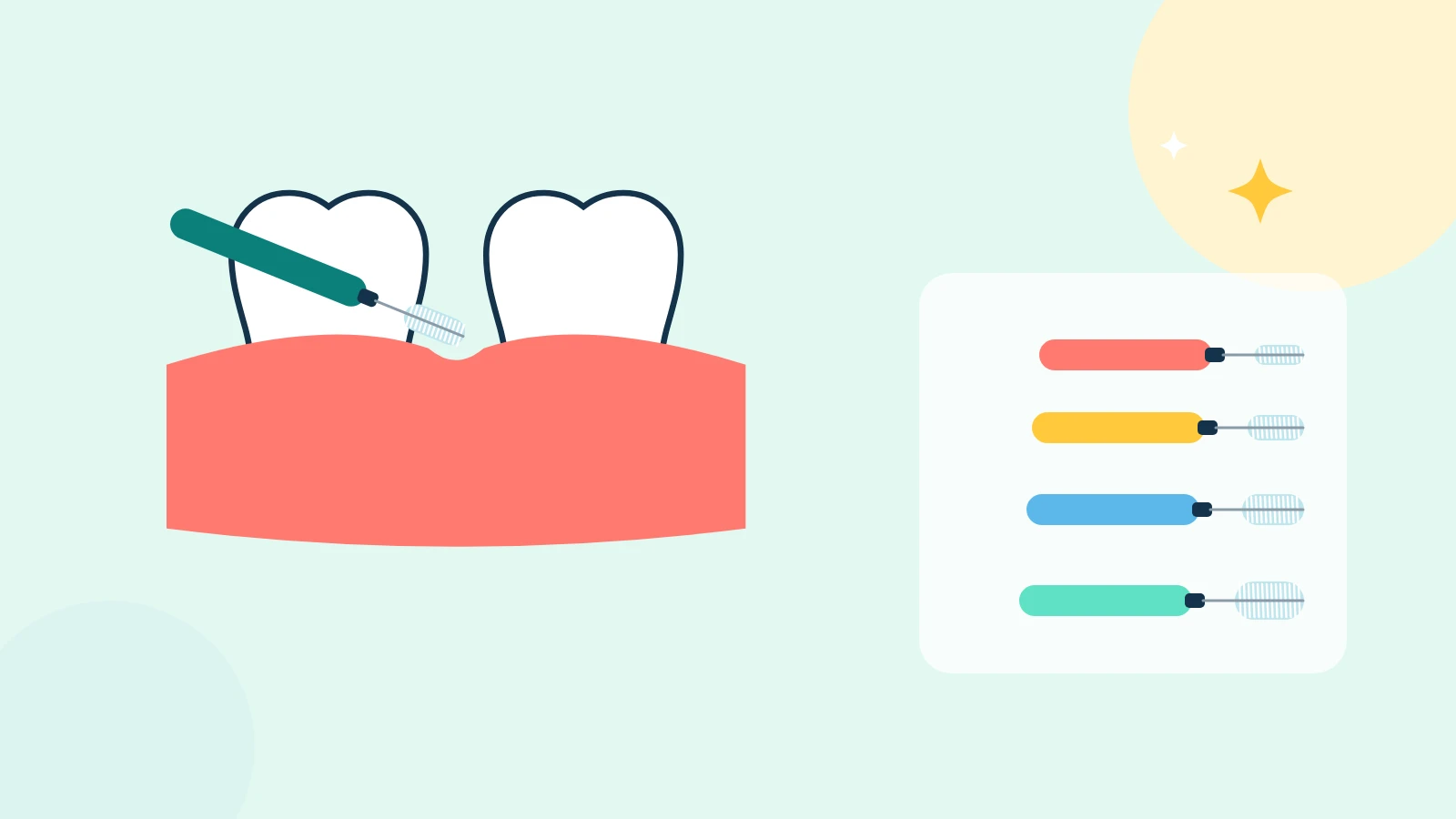
No single size fits every mouth. The NHS says the brush should fit snugly between the teeth, and the ADA says the brushes come in a range of sizes, cone-shaped or cylindrical, to match the space. In a 2025 trial, participants were told to use the brush only in spaces that could take its size. Here is a gentle way to find yours:
Start with the smallest size
Try the smallest brush in one gap where you can see a space, usually between back teeth. It should slide in without force.
Check the fit
A good fit feels snug (NHS): you can feel the bristles against both teeth as you move it, but the wire does not scrape or bend and it does not hurt. If the brush slips through with no contact at all, try the next size up in that gap.
Size down if it resists
If you have to push, the wire bends, or it hurts, that brush is too big for that gap. Go one size smaller, or use floss there instead; the ADA says floss may be the better choice for tight spaces.
Write down your sizes
Note which size fits which part of your mouth.
Get it checked
Your dentist or hygienist can advise on the best way to clean between your teeth (NHS) and confirm your sizes at your next visit.
| What you notice | What it means | What to do |
|---|---|---|
| Slides in gently and you feel the bristles on both teeth | A snug fit (NHS) | Keep this size for this gap |
| Slips through with no contact | Too small to clean the sides | Try one size up |
| Needs pushing, the wire bends, or it hurts | Too big for this gap | Go one size down, or use floss (ADA) |
| Will not go in at all, even the smallest | A tight contact | Use floss here (ADA) |
| Brush around an implant | Implant brushes have coated wire to avoid scratching (ADA) | Ask your dentist which brush to use |
How to use interdental brushes, step by step
This technique follows the instructions given in a 2025 trial of interdental brushes, plus NHS and ADA guidance. Go slowly the first week.
Hold it by the handle and angle it
Hold the brush by its handle. For back teeth, the trial instructions allowed bending the brush so it goes into the gap in a straight line rather than at an angle.
Insert from the cheek side, at gum level
Guide the brush gently into the gap from the outside (the cheek or lip side), at gum level, without pressing into the gum.
Push the bristles all the way through
In the trial, participants inserted the full length of the bristles into the gap, then moved the brush in and out with light pressure (5 strokes in the trial instructions).
Move gap by gap, in the same order
Work around the mouth in the same order each time so no gap is missed, and use only the gaps each size fits.
Rinse the brush
Rinse it under the tap as you go. See the note below on how long to keep a brush.
Once a day
The ADA recommends cleaning between your teeth once a day, and the NHS lists interdental brushes as an alternative to floss, especially where there are gaps.
What about supplement ads? None of the sources here lists a supplement as a substitute for cleaning between your teeth. If ads for ProDentim or ProvaDent have you wondering, the ProDentim review and the ProvaDent review set each vendor's claims beside the published evidence.
Never force it
A brush that has to be pushed is too big. Forcing it can hurt the gum between your teeth. Size down, or use floss in that gap. The NHS also advises against wooden toothpicks for trapped food, because they can damage your gums.
How long does a brush last? The ADA says it does not recommend using devices that clean between the teeth more than once, because they wear and may put bacteria back in your mouth. If a brush's packaging says it is reusable, that is the maker's claim; the ADA's advice is to discard devices for cleaning between your teeth after use. Ask your hygienist if you are unsure.
Where interdental brushes fit in your routine
A simple daily order, using the ADA's and NHS's advice:
| When | What | Source |
|---|---|---|
| Once a day, at a time you will keep | Interdental brushes in the gaps they fit; floss in the tight ones | ADA, NHS |
| Before or after brushing | Either order is fine if you are thorough (ADA); the NHS prefers cleaning between teeth before brushing | ADA, NHS |
| Twice a day | Brush for about 2 minutes with fluoride toothpaste, including last thing at night | NHS |
| After brushing | Spit, do not rinse, so the fluoride keeps working | NHS |
| Regularly | Dental check-ups and cleanings; tell the hygienist which sizes you use | NHS |
If you mix tools, that is normal: the ADA says floss may suit tight spaces and interdental brushes more open ones. The guide on how to floss properly covers the floss gaps. If neither works for you, water flosser vs floss compares another option honestly.
Suppose you bought one pack of medium brushes, found them too big at the front and too loose at the back, and gave up. This time you buy a mixed pack. The smallest size fits snugly between your back teeth; your front teeth are too tight for any brush, so you floss those. You use the brushes every evening before brushing for three weeks. The first week there is a little blood in a few gaps; by week three it is less, and food no longer packs between your back teeth. At your cleaning, the hygienist confirms one gap needs the next size up and shows you how to bend the brush for your last molars.
Are interdental brushes better than floss?
On the evidence so far, possibly, where they fit. The Cochrane review found that interdental brushes used with toothbrushing may reduce gum inflammation and plaque in the short term compared with brushing alone, and may reduce gum inflammation more than floss at one and three months. There was no difference between the tools for deeper gum pockets. The evidence was low certainty, most trials were short, many people in them had mild gum inflammation, and the effects may not be clinically important.
The ADA's practical rule matches: interdental brushes for more open spaces and for people with periodontitis, floss for tight spaces. Early in gum disease, the NHS says a dentist will give advice about keeping your teeth clean, such as using interdental brushes. If your gums bleed, read the bleeding gums guide and gingivitis vs periodontitis for what a dentist checks.
Look for the ADA Seal of Acceptance on interdental cleaners. To compare options: interdental brushes in assorted sizes (Amazon, affiliate link) opens in a new tab or coated-wire interdental brushes for implants (Amazon, affiliate link) opens in a new tab.

Troubleshooting
- If the brush bends every time
- It is too big for that gap, or going in at an angle. Try one size smaller and bend the handle so the brush enters straight, as the trial instructions allowed.
- If your gums bleed
- Inflamed gums bleed easily. Keep going gently once a day. If bleeding keeps up, book a cleaning and exam, especially if your last one was over 6 months ago (MedlinePlus).
- If it hurts
- Size down and lighten the pressure. Cleaning between teeth should not hurt; if it still does, ask your dentist to check the gap.
- If you cannot reach your back teeth
- Open less wide, bend the brush, or try a longer handle. Ask your hygienist to watch you and adjust your angle.
- If no brush fits anywhere
- Your teeth may be close together everywhere. Floss is the ADA's suggestion for tight spaces.
When to see a dentist
Book a dental visit soon if
- Toothache, pain in your gums, or cleaning between your teeth keeps hurting after you size down.
- Gums that keep bleeding: book a dental check, especially if you have not had a cleaning and exam in the last 6 months (MedlinePlus). MedlinePlus says bleeding and tenderness should lessen within 1 or 2 weeks after a professional cleaning with good home care; if yours has not, contact your dentist again.
- Your gums look like they are shrinking (the NHS lists this among the effects of gum disease).
- An adult tooth feels loose or is shifting: ask for an urgent dentist appointment (the NHS puts loose teeth with gum disease in its urgent group).
- Swelling of your gums, face or jaw. A swollen face or jaw, or swelling with a high temperature, needs an urgent dentist appointment (NHS).
- A sore, lump, or red or white patch in your mouth that lasts more than two weeks (NIDCR says to see a dentist or doctor).
- Emergency: trouble breathing, speaking or swallowing, a swollen or painful eye, a lot of swelling in your mouth, or trouble opening your mouth: the NHS says to call its emergency number (999) or go to A&E; in the US, call 911 or go to the emergency room now.
Who to see. Start with a dentist: only an exam (and sometimes an X-ray) can tell gum disease, a cavity, a cracked tooth or an infection apart. No regular dentist, or worried about cost? The National Institute of Dental and Craniofacial Research lists lower-cost options, including dental schools and community clinics, and you can search for a federally funded health center near you on findahealthcenter.hrsa.gov.
The Daily Care start-here page lists the next guides in order.
Frequently asked questions
How do I use an interdental brush?
Pick a size that fits the gap snugly (NHS), slide it in gently from the cheek side at gum level, push the bristles all the way through, and move it in and out a few times with light pressure. Rinse it and move to the next gap. Never force a brush; use a smaller size or floss in tight gaps (ADA).
Is it better to use interdental brushes before or after brushing?
Either works. The ADA says either order is acceptable as long as the cleaning is thorough, while the NHS says it is best to clean between your teeth before brushing. What matters most is doing it once a day, at a time you will keep, and brushing twice a day with a fluoride toothpaste.
How do I use interdental brushes with braces?
None of the sources here gives a technique for braces, so ask your orthodontist or hygienist to show you which size and angle to use around the wires. If brushes are awkward around braces, the guide to water flossers covers another option.
What is the 3-3-3 rule for brushing teeth?
It is not a rule from any of the sources here. The NHS recommends brushing twice a day for about 2 minutes with a fluoride toothpaste, including last thing at night, and the ADA recommends cleaning between your teeth once a day. Spit after brushing rather than rinsing (NHS).
Sources
- How to keep your teeth clean, NHS (accessed October 28, 2026).
- Dental Floss/Interdental Cleaners, American Dental Association (accessed October 28, 2026).
- Home use of devices for cleaning between the teeth (in addition to toothbrushing) to prevent and control gum diseases and tooth decay, Cochrane (accessed October 28, 2026).
- Efficacy of a water flosser compared to an interdental brush on gingival bleeding and gingival abrasion: A 4 week randomized controlled trial, International Journal of Dental Hygiene, 2025 (accessed October 28, 2026).
- Gum disease, NHS (accessed October 28, 2026).
- Gingivitis, MedlinePlus Medical Encyclopedia, U.S. National Library of Medicine (accessed October 28, 2026).
- Oral Cancer, National Institute of Dental and Craniofacial Research (accessed October 28, 2026).
- Dental abscess, NHS (accessed October 28, 2026).

Building a better daily routine? Start here
Brushing, flossing and the tools that make it easier, in the order that helps most, with honest notes on what is worth buying.